SHOP OUR SPRING FLING SALE - 25% OFF ALL TREES NOW! There's no better time to plant once and plant well with our quality stock!

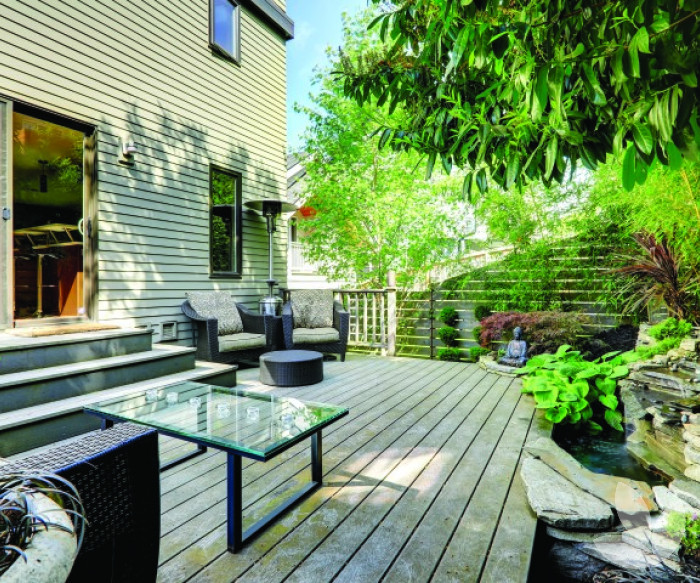
Evergreen vs Deciduous Trees: Which is Right for You?
Many of our Australian customers choose a tree based on how it looks in our nursery, the day they visit. Showy autumn foliage, a promise of summer shade, or a lush green screen grabs them. While it’s great to select your trees with aesthetics in mind, it’s more useful to consider how each tree behaves throughout every season and whether it actually suits your climate, your garden, and your honest appetite for maintenance.
The choice between evergreen and deciduous trees is one we help customers navigate every week at Speciality Trees. After almost five decades growing and supplying containerised trees across Australia, we can say with confidence that neither type is universally better.
The right choice comes down to four things:
- your climate zone,
- the job you want the tree to do,
- how much seasonal variation you enjoy,
- and the maintenance reality you're willing to live with.
This guide walks you through all of it.
What’s the Difference Between Evergreen and Deciduous Trees?
Evergreen trees
An evergreen tree retains its foliage year-round. Rather than dropping leaves all at once in a single season, evergreen trees shed gradually throughout the year, continuously replacing old foliage so the canopy always appears full.
The vast majority of Australia's native trees are evergreen.
This is no accident. Over millions of years, our native flora evolved to handle long dry periods, intense heat, and nutrient-poor soils. Holding onto leaves rather than regrowing them from scratch every season is a far more efficient strategy in our climate. That evolutionary logic is why you'll find evergreen trees thriving from the tropics to the temperate south with very little fuss.
In Australian gardens, year-round foliage provides consistent structure, reliable screening, and steady leaf litter for the compost heap. What it does not mean is zero leaf maintenance. An evergreen is always dropping something. The difference is that it happens gradually rather than all at once.
Deciduous trees
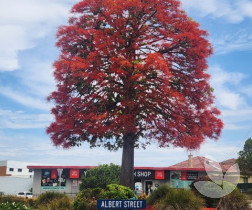
A deciduous tree drops its foliage completely during the cooler or drier months and regrows it in spring. In most of Australia, this is a response to the drop in temperature through autumn and winter. In some tropical areas, certain trees shed leaves in response to the dry season rather than the cold. This dry-season deciduousness is sometimes called drought deciduousness or tropical deciduousness, and it's a well-recognised adaptation in savanna ecosystems. The most commonly grown tree in this group is Brachychiton, particularly B. acerifolius. Known as the Illawarra Flame Tree, and originating from the coast south of Sydney NSW, this striking red flowering tree drops its leaves in summer just before flowering. Both during and after flowering, an unmissable carpet of flowers circles the tree. New foliage growth is lime green, darkening to deep green later in the season. Out of traditional season leaf drop followed by vibrant flowering, makes this selection iconic.
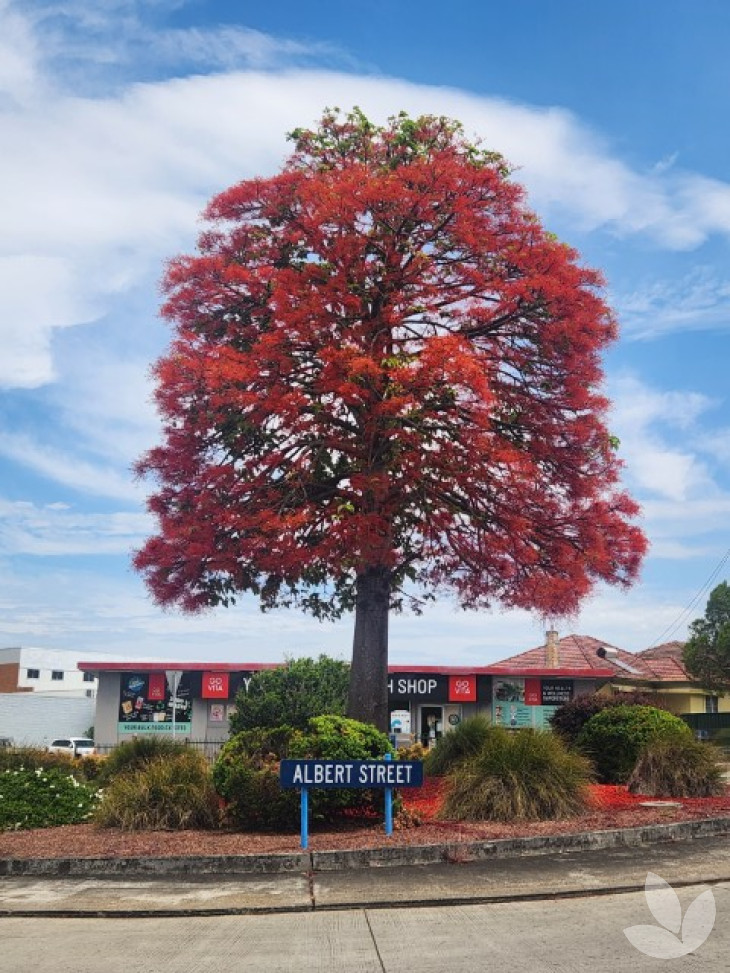
Brachychiton acerifolius (Illawarra Flame Tree) in full red summer bloom on an Australian suburban street
Deciduous trees in Australian gardens are often exotic species: Ornamental Pear, Maple, Oak, Ash, Crepe Myrtle, Ginkgo, and Pistachio. These trees bring something genuinely distinctive to a garden. There's a real wow factor in a tree that performs differently in every season: spring bud burst, full summer canopy, blazing autumn colour, sculptural bare winter silhouette. Four acts in a single tree.
With over 40% of our nursery growing deciduous containerised stock, we have an enormous range to choose from for every climate and use case.
What about semi-deciduous trees?
Here's a category that rarely gets the attention it deserves. Semi-deciduous trees sit somewhere between the two: they lose some or all of their foliage briefly each year, usually during a short period of cold or dry stress, rather than going through full winter dormancy.
A great example of a tree from our range that behaves differently depending on climate is Jacaranda. Native to tropical and subtropical areas of South America and found globally, including throughout Australia, they are known for dropping leaves briefly in late winter or early spring and can sit bare. Contrast this to a warmer climate, where they remain evergreen throughout the year and flower far more vigorously in summer. It is still a stunning tree in the cooler south-east Australian climate, but you should expect differences from what is seen in a warmer, tropical zone.
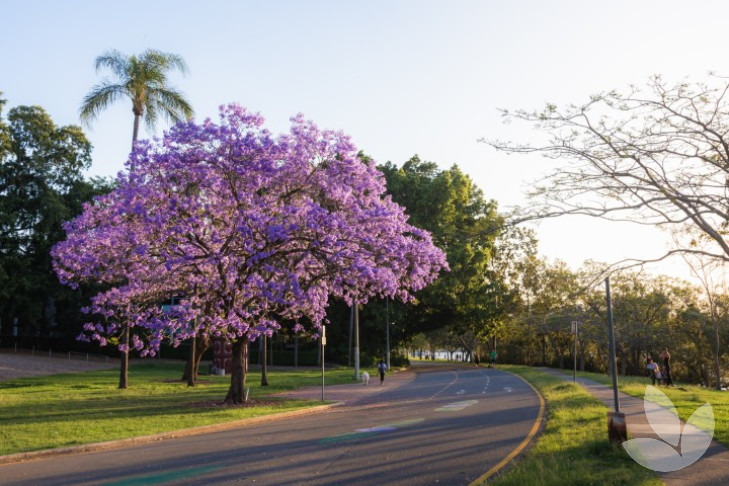
Mature Jacaranda mimosifolia in full purple flower along a roadside in late spring
Jacaranda makes a genuinely versatile choice for gardeners who want some seasonal movement without committing to the full leaf drop of a true deciduous tree.
The reason it matters: some buyers choose a semi-deciduous tree expecting year-round cover, only to be surprised when it drops briefly. Know what you're getting, and you'll love the result.
Choosing the Right Tree for Your Australian Climate
Your climate zone is the single most important filter when choosing between evergreen and deciduous trees. What works beautifully in Victoria can be the wrong call in Queensland. According to the Bureau of Meteorology, Australia spans six distinct climate zones, and tree selection should respect that range.
Cool temperate regions: VIC, TAS, ACT and alpine NSW
This is the climate zone where deciduous trees really earn their keep. In cooler regions, the seasonal behaviour of a deciduous tree maps directly to what you want from your garden at each time of year.
In summer, a full deciduous canopy provides deep, cooling shade. Plant one on the northern side of your home, and it will intercept the harshest sun during the months you most want it. Then in autumn, the leaves drop just as you want winter sun back on your home and outdoor living areas. This is the principle behind passive solar design, and deciduous trees are one of the most effective tools for achieving it without a single piece of infrastructure.
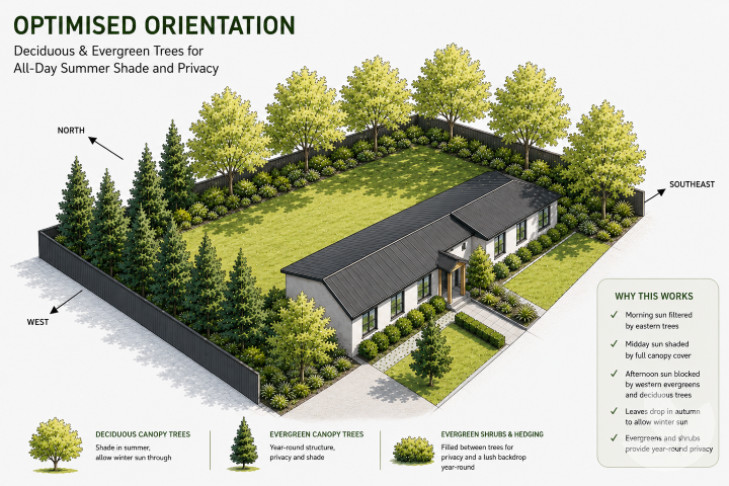
Infographic illustrating the optimal placement of deciduous and evergreen trees around an Australian home to maximise summer shade, allow winter sunlight and provide year-round privacy.
The autumn colour display is a genuine bonus. Few things in an Australian garden match the intensity of a Scarlet Oak (Quercus coccinea) in April, or the clean, luminous gold of a Maidenhair Tree (Ginkgo biloba) before the leaves fall.
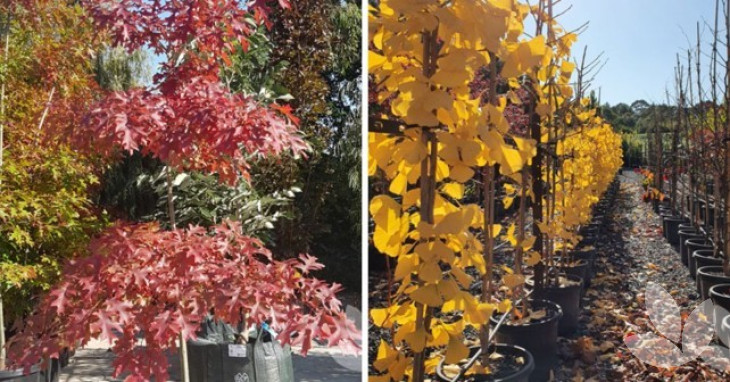
Created in Canva: Scarlet Oak (Quercus coccinea) in red autumn foliage beside Maidenhair Tree (Ginkgo biloba) in golden autumn colour
Evergreen trees still play an important role in cool temperate gardens, particularly for year-round screening, windbreaks, and structural plantings. The strongest cool-temperate gardens typically use both: deciduous trees on the northern aspect and as feature trees, evergreen trees along the boundaries.
Warm temperate and subtropical: coastal NSW and south-east QLD
A mixed approach works beautifully here. Deciduous trees still deliver a reliable seasonal performance in areas with a meaningful temperature drop in winter. Crepe Myrtles (Lagerstroemia), Chinese Pistachio (Pistacia chinensis), and Manchurian Ornamental Pear (Pyrus ussuriensis) all perform strongly across this zone.
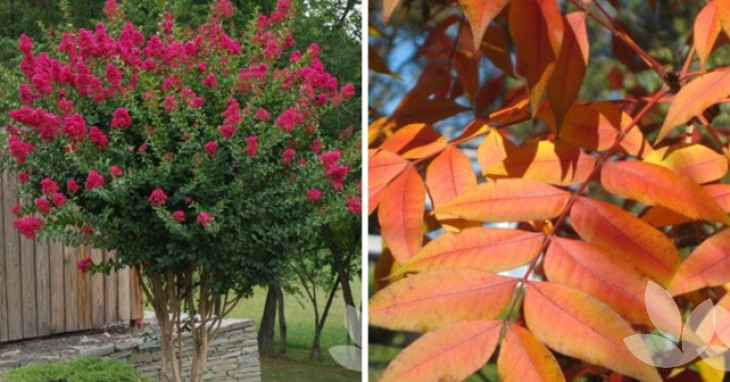
Creatsed In Canva: Crepe Myrtle (Lagerstroemia) in pink summer flower and Chinese Pistachio (Pistacia chinensis) showing red-orange autumn foliage
The passive solar argument is less compelling in Victoria than in other parts of Australia because winters are milder and you're less likely to want to maximise winter sunlight on your home.
The aesthetic case for deciduous trees remains strong, and many subtropical gardens use them as feature trees or to add seasonal interest to otherwise evergreen landscapes.
Tropical and dry tropical: northern QLD, NT and northern WA
Evergreen trees are the clear choice in tropical Australia. Cold-climate deciduous varieties struggle with mild winters and intense wet season conditions. The relevant distinction in this zone is not evergreen versus deciduous, but between species adapted to the wet season and those suited to dry season conditions.
It's worth noting that some native trees in northern Australia are technically deciduous, dropping their leaves not in response to cold but to the dry season. This is a different evolutionary mechanism from the autumn leaf drop of European deciduous trees, and these dry-deciduous species are specifically adapted to the tropical Australian environment.
Mediterranean climate: SA and south-west WA
In the hot, dry summers and mild, wet winters of Mediterranean-climate Australia, drought tolerance becomes the primary selection filter. Evergreen trees with proven drought tolerance are well-suited to structural plantings and screens in this zone.
If you want deciduous trees in this climate, look for species with good summer tolerance and an established track record in Mediterranean conditions. Ornamental pears, Chinese Pistachio, and Maidenhair Tree all handle this zone well with appropriate care through the establishment period.
Which Type of Tree Is Right for Your Garden?
Privacy and screening: go evergreen
For year-round privacy, evergreen trees are the answer. A deciduous screen loses its effectiveness completely in winter, and for most homeowners, that defeats the purpose.
Portuguese Laurel (Prunus lusitanica) offers dense and attractive deep green foliage no matter the season for full privacy. In spring, this wall of green is scattered with a mass of pendulous small white flowerheads creating a stunning floral wall.
If you love the look of a deciduous variety but still need year-round privacy, consider layering: a taller deciduous tree above, with an evergreen understorey below. You get the seasonal drama at height and the persistent privacy where it matters most.
Shade and passive solar design: think deciduous
If your goal is to manage sun and heat across the seasons, deciduous trees are the more versatile tool. A full canopy in summer, winter light access after leaf drop: this is effective passive solar design at garden scale, and you don't need to be an architect to use it. Plant a deciduous tree on your home's northern aspect and let it do the work.
For consistent shade in all seasons, particularly over an outdoor dining area or entertaining space you use year-round, an evergreen tree is the more reliable choice.
Feature trees and seasonal interest: both, for different reasons
Both types produce stunning feature trees. The question is the kind of performance you're after.
A deciduous tree gives you four distinct acts: spring bud burst, full summer canopy, autumn colour, bare winter silhouette. There's genuine seasonal excitement in a garden built around deciduous feature trees. Our Ginkgo biloba (Maidenhair Tree) is one of those trees that stops visitors in their tracks every single May.
An evergreen feature tree gives you presence and constancy. Magnolia grandiflora 'Kay Parris' grows to around 5 metres with a dense, upright form, rich glossy dark green foliage with rust-coloured undersides, and creamy white fragrant flowers through the warmer months. It's a tree that earns its space in every month of the year.
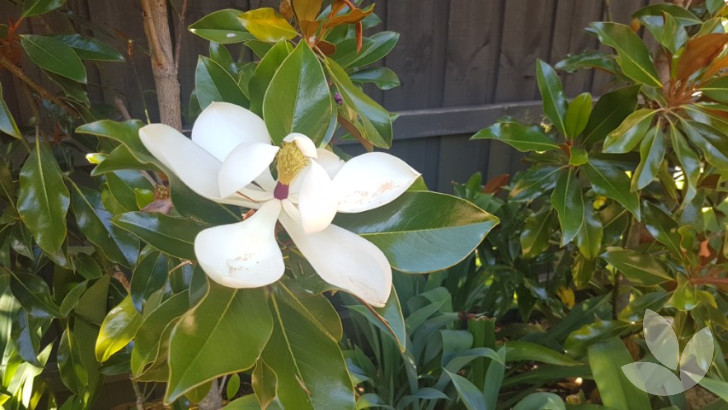
The flower of the Magnolia grandiflora 'Kay Parris'
The question to ask yourself: do I want my garden to change with the seasons, or do I want it to be reliably beautiful year-round?
Most great gardens find room for both answers.
Trees near pools: the answer may surprise you
This one comes up constantly, and the answer challenges the assumption most people bring to it: both evergreen and deciduous trees can work near a pool.
All trees shed leaves. Evergreen trees shed gradually throughout the year, which means your pool skimmer stays busy but never overwhelmed. Deciduous trees shed seasonally, which means a concentrated period of leaf management in autumn and a relatively calm period the rest of the year.
What matters more than the evergreen or deciduous distinction is the actual volume of leaf material, the size of individual leaves, and how well the tree handles the specific conditions near water: wind, salt, chlorine, and soil type. Don't be scared to use a beautiful deciduous variety poolside because of a manageable seasonal clean-up.
Browse our evergreen and deciduous trees suited to poolside planting for the varieties we recommend most often for this situation.
Learn more in our blog post: Evergreen or deciduous trees around pools.
Maintenance: What You're Really Signing Up For
Neither type of tree is maintenance-free. Here is an honest account of what each actually involves.
Deciduous tree maintenance
The most obvious commitment is autumn and winter leaf collection. In cool temperate climates, a single large deciduous tree can drop a significant volume of leaves across a few weeks. The good news is that this material has genuine value in the garden: deciduous leaf matter breaks down into excellent mulch and enriches your soil year after year.
Pruning is typically done in late winter dormancy, when the canopy is clear, and the tree can heal well before the burst of spring growth.
At Speciality Trees a significant block of potting takes place when limbs are bare.
As growers, winter is the perfect time for formative pruning to promote a robust and balanced framework for continued growth. For the buyer, this structure is exposed to the world, so it is the perfect time to appreciate what you are buying. To the landscape, planting deciduous trees in winter dormancy is a low-risk thing to do.
Evergreen tree maintenance
Evergreen trees demand more consistent care throughout the year. Water and nutrient requirements don't pause for winter: an evergreen tree in active growth needs the same attention in July that it needed in January.
Pruning requires more care because there is no dormancy window to work with. Severe pruning at the wrong time can put an established evergreen under real stress. Light, regular maintenance pruning is a much better approach than occasional heavy cutting.
The leaf maintenance burden is lower overall, but it is spread across every season rather than concentrated in one.
Evergreen vs Deciduous Trees at a Glance
| Feature | Evergreen | Deciduous |
|---|---|---|
| Leaf retention | Year-round | Drops seasonally (autumn/winter) |
| Year-round privacy | Yes | No -- gaps in winter |
| Passive solar benefit | No | Yes -- winter light access after leaf drop |
| Autumn colour | Generally no | Yes, often striking |
| Seasonal leaf cleanup | Low and gradual | Higher and concentrated in autumn |
| Best for poolside | Yes (lower seasonal drop) | With planning, yes |
| Best climate zones | All Australian zones | Cool to warm temperate |
| Common uses | Screening, windbreaks, year-round structure | Feature trees, shade, seasonal interest |
Tree Varieties We Love for Australian Gardens
Evergreen trees we love
- Arbutus ssp. (subspecies) e.g.unedo or canariensis
- Tristaniopsis laurina ‘Luscious’®PBR
- Corymbia citriodora (Lemon Scented Gum) and its dwarf version ‘Scentuous’
- Eucalyptus sideroxylon Rosea
- Brachychiton rupestris (can be semi-deciduous)
Deciduous trees we love
- Nyssa sylvatica ST1 ‘Red Rush’
- Ginkgo biloba ‘Lemonlime Spire’
- Acer palmatum (Japanese Maple) and ssp. (there are many outstanding colour variations)
- Liriodendron tuliperifera (Tulip Tree)
- Cercis canadensis ‘Forest Pansy’
Ready to Find the Right Tree for Your Garden?
The right answer to the evergreen versus deciduous question is almost always: it depends, and quite often, both. The strongest Australian gardens use a mix of the two, with evergreen trees providing the framework and deciduous trees providing the seasonal character.
Ready to choose? We grow one of Australia's largest ranges of containerised evergreen and deciduous trees, with stock suited to every climate zone covered in this guide. Browse our evergreen and deciduous trees, or contact our team for tailored advice on what will work best in your garden.
Frequently Asked Questions
Are most Australian native trees evergreen or deciduous?
Most Australian native trees are evergreen. Over millions of years, Australian native flora evolved to handle prolonged dry periods and nutrient-poor soils. Retaining foliage year-round is a more efficient strategy in these conditions than seasonal regrowth. Some native trees in tropical northern Australia are briefly deciduous, shedding leaves in the dry season rather than in response to cold.
Which type of tree is better for privacy?
For year-round privacy, evergreen trees are the better choice. Deciduous trees lose their foliage in winter and provide little to no screening for several months each year. If year-round privacy is your primary goal, choose an evergreen. If you want some deciduous character in a boundary planting, combine a deciduous tree with an evergreen understorey to maintain winter coverage.
Can I mix evergreen and deciduous trees in the same garden?
Yes, and for most Australian gardens, this is the best approach. Deciduous trees provide seasonal interest, autumn colour, and winter light access; evergreen trees provide structure, consistent screening, and year-round greenery. Mixing the two creates a garden that moves through the seasons while maintaining a strong, reliable framework throughout the year.
What is a semi-deciduous tree?
A semi-deciduous tree is partially or briefly leafless during periods of cold or dry stress, rather than going through full seasonal dormancy. In warm climates, semi-deciduous species may hold their foliage almost year-round. In cooler areas, they may shed briefly in late winter. The Chinese Elm (Ulmus parvifolia 'Burnley Select') is a widely grown semi-deciduous tree suited to a broad range of Australian garden conditions.
Do deciduous trees grow well in Queensland?
Some do. Ornamental species, including Crepe Myrtle (Lagerstroemia) and Chinese Pistachio (Pistacia chinensis) perform well across most of Queensland. Cold-climate deciduous species such as Liquidambar and some ornamental pears perform less reliably in tropical northern Queensland, where winters are too mild to trigger effective dormancy. Across south-east Queensland and coastal NSW, the range of viable deciduous trees is much broader.



Receive all the latest news, product information, collections, projects, tips and special offers straight to your inbox each month or so.
Receive all the latest news, product information, collections, projects, tips and special offers straight to your inbox each month or so.
Find a Tree
With more than 400 trees in our library we can help you find the perfect tree for your next project.
Ask a question
We're here to help if you need any advice on selecting the perfect tree for your next project.
Newsletter
Receive all the latest news, product information, collections, projects, tips and special offers straight to your inbox each month or so.
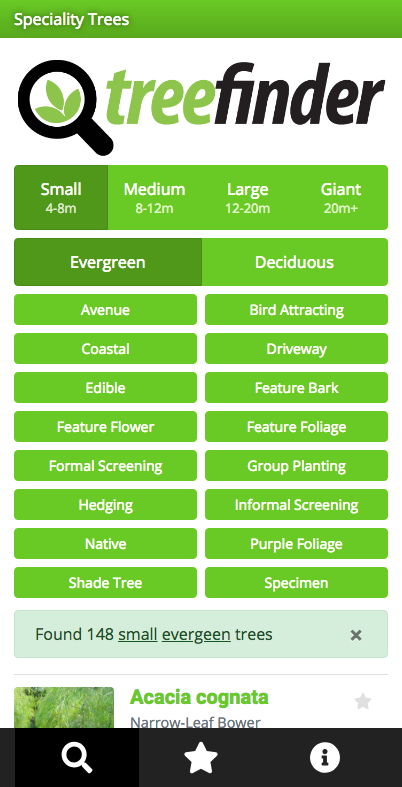
Treefinder can help you identify the perfect tree for your next project!
With over 400 tree varieties for review, the Treefinder app enables you to conveniently browse and compile a list of trees suitable for a number of common landscaping uses - from attracting birds to creating a formal screen or hedge. By selecting desired size, foliage, and a few categories, Treefinder opens up a world of possibilities.
Once you've found the perfect tree you can click through to our website for more information, availability and a quote.

We are specialists in the environmentally sustainable production of premium quality advanced landscaping trees and screens.
For more than 49 years Speciality Trees has been a leader in the production and supply of advanced environmentally sustainable, containerised landscape trees for local government, the landscaping industry and retailers.
Learn more




Trees
© 2026 Speciality Trees Pty Ltd. All Rights Reserved.
Speciality Trees acknowledges the traditional custodians of the lands where we live, learn and work, and acknowledge and respect all who have contributed to it, past, present and future.