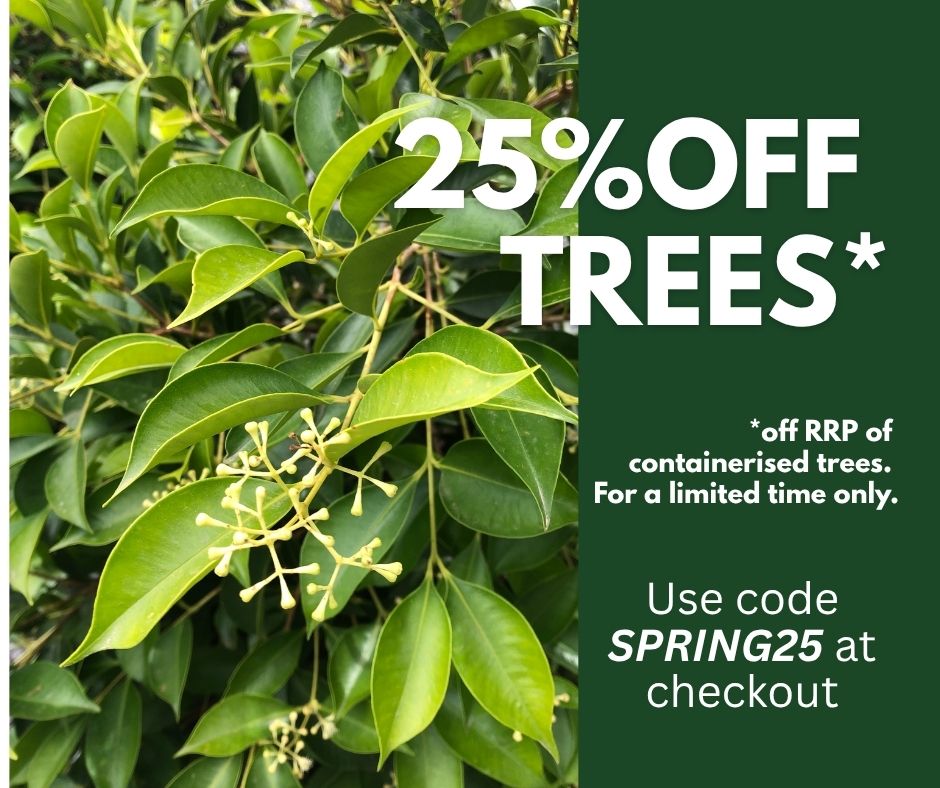
SHOP OUR SPRING FLING SALE - 25% OFF ALL TREES NOW! There's no better time to plant once and plant well with our quality stock! Or contact us to place an order direct.

Foliage-Accentuated Weeping Standards Collection
Grafted weeping standards are ideal as a feature tree in a compact landscape. These varieties have been chosen specifically for their outstanding foliage form and colour, particularly in autumn, where some take centre stage.

What is a Weeping Standard Tree?
A weeping standard is a tree that is created by grafting a naturally pendulous or cascading variety onto an upright trunk at a set height. The result is a tree with a clear stem and a defined “head” of branches that arch or fall gracefully towards the ground.
They’re known for their stunning autumnal colour or feathery green foliage.
The term standard refers to the straight trunk, while weeping describes the growth habit of the canopy. Rather than growing upright or spreading horizontally, the branches drape downwards, forming a soft, umbrella-like silhouette.
Most weeping standards are grafted at a consistent height, typically between 1.5 and 1.8 metres, which creates uniformity across a landscape design. This structure makes them particularly effective as feature trees in compact gardens, courtyards, entry statements or formal plantings.
Depending on the variety, they can be grown for foliage form, autumn colour, flowers or architectural winter structure. Deciduous types provide seasonal variation, while evergreen forms deliver year-round presence.
In essence, weeping standards combine strong vertical structure with flowing form, making them a refined and space-efficient feature tree option.
Why Weeping Standard Trees Are Popular Across Australia
They’re growing in popularity across Australia due to two significant reasons:
- Their strong architectural form
- and adaptability to smaller spaces.
With urban block sizes decreasing, homeowners and designers are seeking feature trees that deliver visual impact without overwhelming a site. The elevated graft height provides structure, while the cascading canopy softens hard surfaces and built environments.
Their predictable shape is another key advantage.
Because they are grafted at a set height, the overall form is consistent and controlled. This makes them well-suited to formal gardens, driveway plantings, courtyard designs and symmetrical layouts where balance matters.
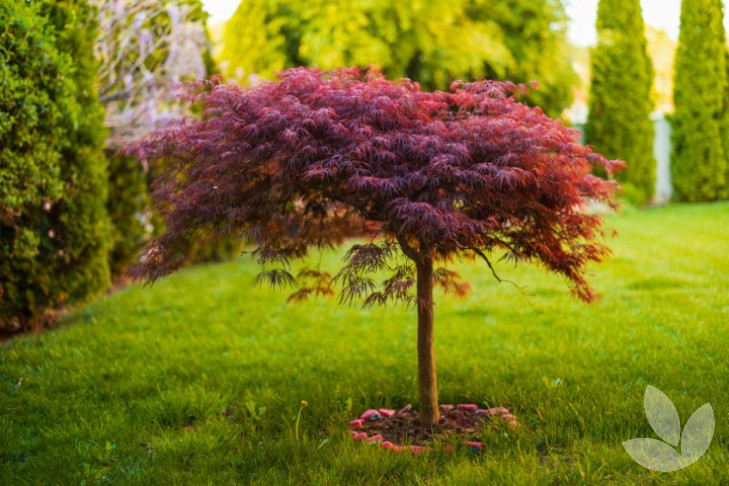
A beautiful Weeping Japanese Maple
Many varieties grow successfully across temperate regions, offering seasonal highlights such as spring flowering, vibrant autumn foliage or sculptural winter branches. Deciduous weeping standards, in particular (such as Acer palmatum (Weeping Japanese Maple), allow winter sunlight into homes while providing summer shade.
Maintenance requirements are generally straightforward. With pruning focused on maintaining the canopy shape rather than managing excessive height, they offer a manageable solution for residential gardens, commercial landscapes and streetscapes alike.
The combination of structure, seasonal interest and space efficiency explains why weeping standard trees remain a consistent choice across Australia’s diverse landscape styles.
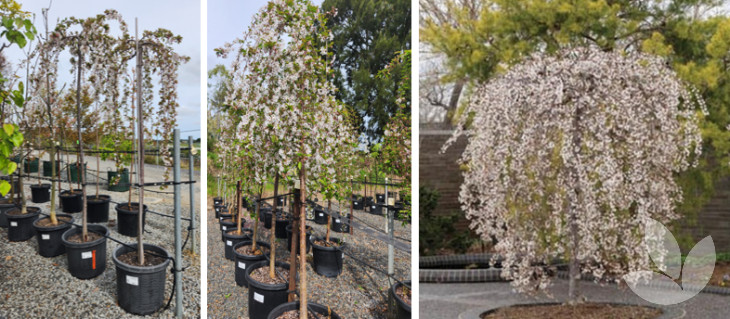
Flowering ornamental Cherry (Prunus 'Snofozam') growing in the Nursery and then planted in the garden.
Landscape Applications for Weeping Standards
Flowering grafted weeping standards are frequently used as courtyard centrepieces, where their elevated canopy provides structure without overwhelming confined spaces. The defined trunk and cascading head create a natural focal point, particularly effective in paved or architectural settings where softer planting is required to balance hard surfaces.
They also perform well when positioned to flank entryways or gateways, introducing symmetry and visual order. Along pathways, their umbrella-like form can frame movement through a garden, guiding the eye while maintaining openness beneath the canopy.
In more formal garden layouts, weeping standards contribute to structured symmetry. Their consistent graft height ensures alignment across planting schemes, making them well-suited to driveway plantings, geometric beds or repeating garden rhythms.
Around pools and entertaining areas, they soften built elements without creating excessive shade or debris at ground level. Planted in raised planters, they add vertical interest and refinement to terraces, courtyards or rooftop gardens.
The clear stem beneath the canopy allows visibility through the landscape and provides space for underplanting, enabling layered garden designs without visual congestion.
Key Characteristics of Grafted Weeping Standards
- Typically grafted at a uniform height of 1.5–1.8 metres, creating a clear stem and elevated canopy
- Defined cascading canopy with a refined, umbrella-like form
- Controlled mature spread, ideal for compact or structured landscapes
- Well-suited to small gardens, courtyards and urban environments
- Strong seasonal interest, including spring growth, autumn colour and sculptural winter form
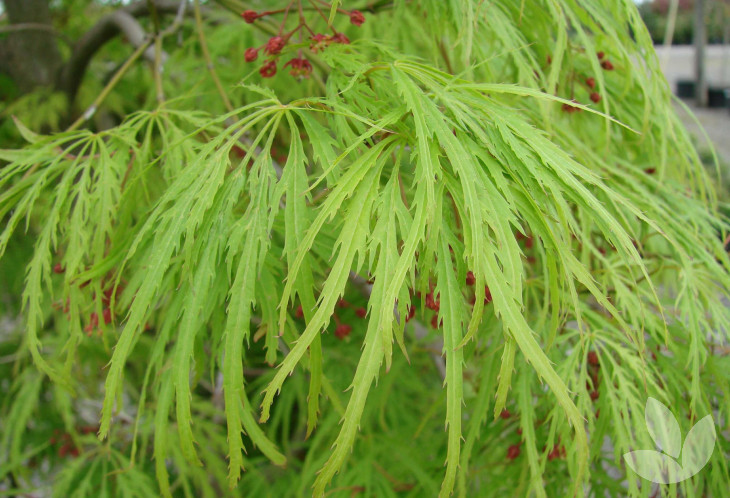
Foliage of Acer palmatum 'Viridus' (weeping standard)
Planting & Considerations
Successful establishment begins with selecting a well-drained planting site suited to the specific variety.
Most grafted weeping standards prefer fertile, free-draining soils and benefit from soil improvement prior to planting, particularly in heavier clay conditions. Positioning is equally important.
Deciduous varieties such as Japanese maples perform best with protection from harsh afternoon sun and strong winds, while ensuring adequate light for healthy canopy development.
Because these trees are grafted at a fixed height, the graft union should remain above the soil level and free from mulch build-up. Staking may be required during early establishment to protect the clear stem and stabilise the graft point, especially in exposed sites.
Watering is critical during the first growing seasons to encourage deep root development. Applying organic mulch around the base assists with moisture retention and temperature regulation, while keeping it clear of the trunk prevents collar rot.
Ongoing maintenance is generally minimal. Pruning focuses on preserving the defined canopy shape, removing any vigorous upright shoots that disrupt the weeping habit, and maintaining balanced structure. With appropriate placement and early care, grafted weeping standards provide long-term performance and consistent form within the landscape.
Professional Supply & Availability
Speciality Trees grows a considered range of grafted weeping standards selected for foliage quality, seasonal performance and structural consistency. Each tree is professionally propagated and grafted to a uniform height, ensuring predictable form and reliable landscape outcomes.
Availability may vary seasonally depending on variety and grade, with advanced specimens and field-grown stock offered subject to production cycles. Early enquiry is recommended for landscape projects requiring specific quantities or coordinated planting schedules.
Our team can provide guidance on variety selection, mature dimensions and suitability for your climate and site conditions. For current availability, pricing or project supply, please contact the team on 03 9554 2000 or submit an enquiry online
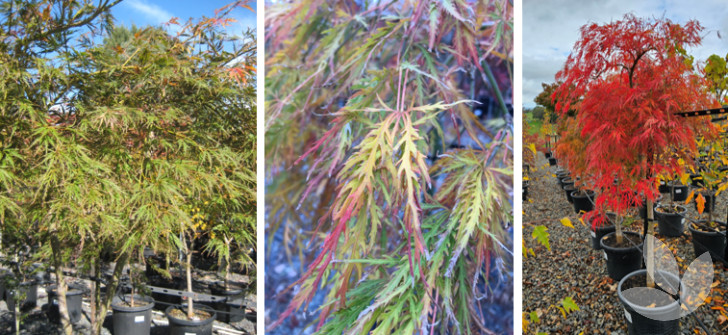
Changing colours of Acer palmatum 'Ornatum Bronze' from Summer to Autumn
FAQs
What height are grafted weeping standards supplied at?
Most weeping standards are grafted at approximately 1.5–1.8 metres, creating a consistent trunk height with a defined cascading canopy.
How much space do grafted weeping standards need to grow?
While the trunk height remains fixed, the canopy will expand over time depending on the variety. Mature spread varies, so it is important to consider clearance from paths, structures and neighbouring plants.
Are weeping standards suitable for small gardens?
Yes. Their controlled form and elevated canopy make them ideal for courtyards, narrow spaces and urban landscapes where vertical structure is desired without excessive width.
Do grafted weeping trees require special maintenance?
Maintenance is generally straightforward. Occasional pruning helps maintain canopy shape and remove any vigorous upright shoots that may alter the weeping habit.
Can they be planted in pots or raised planters?
Select varieties can perform well in large containers, provided drainage is adequate and watering is monitored carefully, particularly during warmer months.
Featured Weeping Standards


Receive all the latest news, product information, collections, projects, tips and special offers straight to your inbox each month or so.
Receive all the latest news, product information, collections, projects, tips and special offers straight to your inbox each month or so.
Find a Tree
With more than 400 trees in our library we can help you find the perfect tree for your next project.
Ask a question
We're here to help if you need any advice on selecting the perfect tree for your next project.
Newsletter
Receive all the latest news, product information, collections, projects, tips and special offers straight to your inbox each month or so.
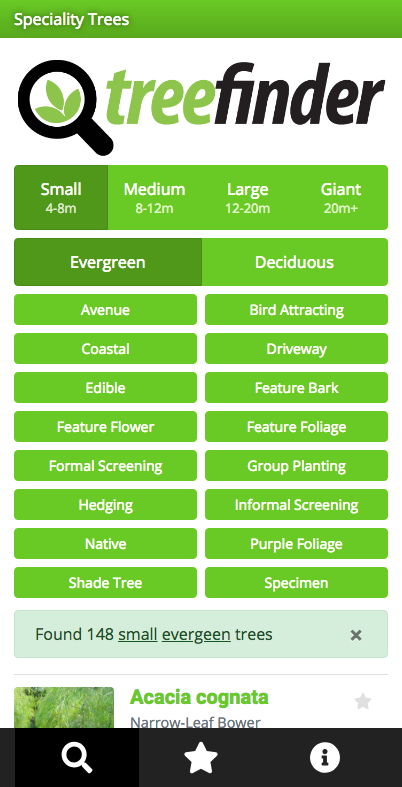
Treefinder can help you identify the perfect tree for your next project!
With over 400 tree varieties for review, the Treefinder app enables you to conveniently browse and compile a list of trees suitable for a number of common landscaping uses - from attracting birds to creating a formal screen or hedge. By selecting desired size, foliage, and a few categories, Treefinder opens up a world of possibilities.
Once you've found the perfect tree you can click through to our website for more information, availability and a quote.

We are specialists in the environmentally sustainable production of premium quality advanced landscaping trees and screens.
For more than 49 years Speciality Trees has been a leader in the production and supply of advanced environmentally sustainable, containerised landscape trees for local government, the landscaping industry and retailers.
Learn more




Trees
© 2026 Speciality Trees Pty Ltd. All Rights Reserved.
Speciality Trees acknowledges the traditional custodians of the lands where we live, learn and work, and acknowledge and respect all who have contributed to it, past, present and future.