SHOP OUR SPRING FLING SALE - 25% OFF ALL TREES NOW! There's no better time to plant once and plant well with our quality stock! Enter SPRING25 in the website cart or contact us to order directly.


Screening Plants Around Pools for Privacy
In short: the best screening trees around pools are dense evergreens with small leaves, little or no fleshy fruit and non-invasive roots, positioned so that mature growth stays clear of the 900 mm non-climbable zone around the pool barrier. 'Whisper' Lilly Pilly suits wide boundaries, 'Straight and Narrow' suits tight strips, and 'Coppertop' Viburnum suits small surrounds.
Screening a pool is one of the most commonly asked questions we get in the business, and it has only become more common as the community battles with bigger houses on smaller blocks. The pool is usually the most exposed part of the garden and the last part anyone plans for.
Poolside planting also has constraints the rest of the garden does not. There is a safety barrier to work around, water that shows every leaf, paving and plumbing that roots can lift, and either chlorine or salt in the splash zone. Get the selection right and the maintenance looks after itself. Get it wrong and you are skimming the pool before breakfast.
We have been producing advanced landscape trees in Victoria for more than 49 years, so the notes below come from what we see in the production nursery enviroment and in the landscapes we supply. Every tree here is evergreen except where stated, and each one is matched to the amount of room you actually have.
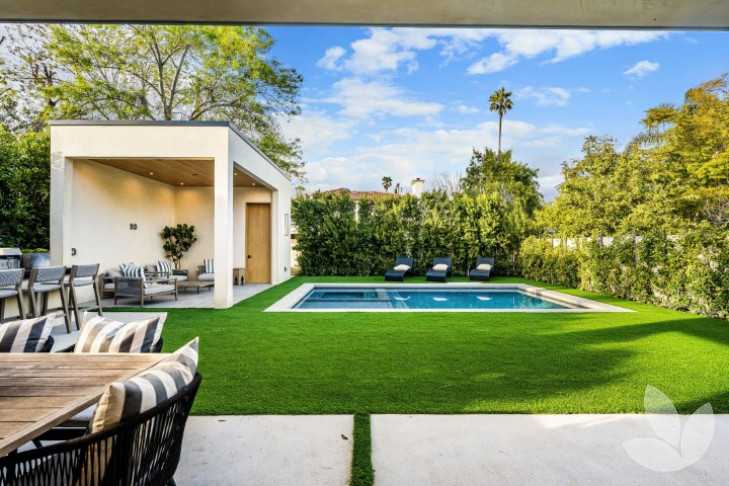
Screening plants around a pool, planted for privacy along a boundary fence
What Makes a Plant Suitable for Screening Around a Pool?
A screening tree suits a pool when it holds 90 per cent of its foliage year-round, drops minimal rather than large litter, produces little or no fleshy fruit, has a fibrous root system that will not lift paving, and can be set back far enough that mature growth stays outside the non-climbable zone around the barrier. Mature width matters more here than anywhere else in the garden, because a pool surround is usually a strip.
These are the five things we work through with customers:
- Barrier compliance. Where the tree can physically go.
- Litter. The elements of the tree have the potential of landing in the water and causing issues.
- Roots. What sits under the paving, the coping and the return lines.
- Water and wind. Chlorine splash, salt backwash, and how exposed the planting position is.
- Mature size. Whether the tree fits the strip you will have in ten years, not the one you have now.
Where Can You Plant Near a Pool Fence?
You can plant outside the 900 mm non-climbable zone, not inside it. Under AS 1926.1-2012, the Australian Standard for pool barriers, a 900 mm zone is measured as an arc from the top of the barrier, and no climbable object may sit inside it. Trees and shrubs count, and so do their mature branches.
In practice that means two things. Set the tree back far enough that its spread at maturity does not grow into the zone, and choose something dense enough to screen without needing to be cut hard on one side every season.
Requirements differ between states and are enforced by your local council or pool safety inspector, so confirm the setback for your own barrier before you plant. The Swimming Pool and Spa Association sets out the national zones, and Victoria's Building and Plumbing Commission publishes the Victorian requirements.
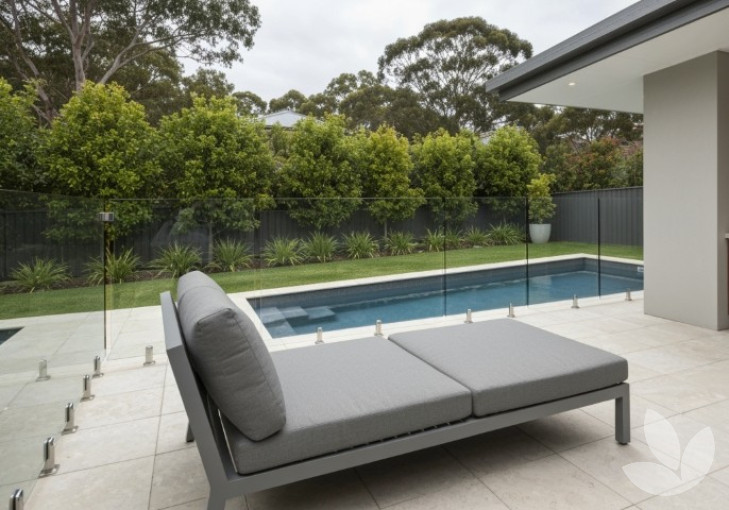
Screening tree planted clear of the non-climbable zone beside a pool fence
Do All Trees Drop Leaves Into a Pool?
Yes. Every tree sheds, evergreen trees included. Evergreen trees drop a little at a time through the year rather than all at once in autumn. The useful question is not whether a tree drops leaves but the size of the litter and leaf it drops. Small leaves can get wedged in the filter, whereas larger leaves, depending on their size, could be blocked from entering the filter at all. The small fruit of Lilly Pilly can be minimised in many cases by pruning the hedges directly after flowering to prevent the production of fruit.
Try to understand what your trees will do regardless if you select evergreen or deciduous varieties, and our separate collection on why we suggest both evergreen and deciduous around pools may provide you some landscaping inspiration here. For a privacy screen however, evergreen wins every time and something you require in July as much as in January.
In the Lilly Pilly category, Waterhousea 'Whisper' is a tree we point poolside customers to first. It grows tall, full and lush and is easily clipped to shape only producing minimal quantities of small green berries compared to other varieties.
Are Trees Salt and Chlorine Tolerant?
Splash and backwash are two different problems. Chlorinated splash scorches leaf margins on sensitive species but rarely troubles an established tree. Saltwater pools are the harder case, because repeated backwash into a garden bed raises salt in the soil over time, and that can take a toll on trees and plants.
If you have a saltwater pool, plant coastal species and direct backwash away from garden beds. Of the selections here, 'Sentinel' Banksia is one very well suited to sandy soils and coastal positions. Lilly Pilly copes with splash well enough but may not forgive backwash in the root zone.
Screening Trees for Wide Pool Boundaries
Where you have a boundary to cover rather than a strip to fill, these four give height and density. All reach 6 m or more and will hold foliage to the base if you let them.
Waterhousea floribunda 'ST1' Whisper (Weeping Whisper Lilly Pilly)
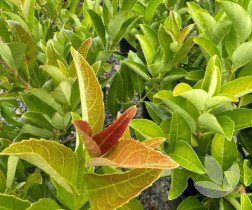
A real favourite, and the one we recommend most often for poolside screening. It reaches 8 x 5 m with a pendulous, bushy habit that softens an ugly fence line rather than ruling a hedge along it. New growth comes through pink and orange before maturing to green, and it carries only minimal quantities of small green berries, which is unusual for a lilly pilly and the reason it belongs near water. Tolerant of most soils in full sun to part shade, it copes with occasionally wet conditions and responds well to pruning, including being lifted from the base to raise the canopy. It will cope with some frost as long as it is not sustained or extreme.
View Waterhousea floribunda 'ST1' Whisper | Typical container sizes: 40 cm/27L, 50 cm/52L, 100L, 150L, 200L
Tristaniopsis laurina 'DOW10' Luscious (Luscious Kanooka Gum)
An updated Kanooka Gum with larger, shinier dark green leaves, reaching 8 x 4 m in an oval form. Deep purple bark peels back to a smooth cream trunk, and sweetly perfumed yellow flowers appear in clusters through summer. It tolerates a wide range of soil and climate conditions including frost, which makes it the most adaptable screen in this group, though it is not suited to very hot or dry climates or to hot wind exposure without regular watering. Happy in most moist, well-drained soils in full sun.
View Tristaniopsis laurina 'DOW10' Luscious | Typical container sizes: 40 cm/27L, 50 cm/52L, 100L, 150L
Olea europaea 'Tolley's Upright' (Tolley's Upright Olive, low fruiting)
Reaching 7 x 4 m with an upright habit and silvery evergreen foliage, this is the choice where the pool setting is Mediterranean rather than subtropical. The reason it is in a poolside collection at all is that it is a low-fruiting variety, so there is none of the fruit staining that rules ordinary olives out near paving. It tolerates most soils and prolonged dry periods, prefers a sunny position, and can be grown with a single leader or pruned into a hedge for screening.
View Olea europaea 'Tolley's Upright' | Typical container sizes: 40 cm/27L, 50 cm/52L, 150L
Syzygium australe 'Hinterland Gold' (Hinterland Gold Lilly Pilly)
A fast-growing native reaching 6 x 3 m with a dense oval habit and compact glossy foliage that flushes coppery on the new growth. White fluffy blossom through the warmer months is followed by fleshy red berries, so keep it back from paving and water where staining matters. It will tolerate most soils and prefers moist, well-drained ground in full sun to part shade. An ideal native shrub for hedging and screens and a good selection for around pools where you have the width for it.
View Syzygium australe 'Hinterland Gold' | Typical container sizes: 40 cm/27L, 50 cm/52L
Narrow Screening Trees for Tight Poolside Strips
Most pool surrounds do not have room for a 4 m canopy. These two hold a narrow form at maturity, which is what lets you screen a boundary from a strip barely a metre wide.
Syzygium australe 'SAN01' Straight and Narrow (Straight and Narrow Lilly Pilly)
Reaching 5 to 8 x 1 to 1.5 m, this holds a naturally columnar form with dense foliage to the base. It is a better form than the narrow-growing 'Pinnacle' because of that density, and it works as a native alternative to the Italian pencil pine. Tolerant of cold and dry periods once established, happy in full sun to part shade, and only occasional pruning is needed to keep it neat. It carries reddish-pink fruit, so allow for that where it overhangs paving.
View Syzygium australe 'SAN01' Straight and Narrow | Typical container sizes: 40 cm/27L, 50 cm/52L
Banksia integrifolia 'Sentinel' ('Sentinel' Banksia)
At 3 x 1 m in a fastigiate form, this is the narrowest selection here and the only one chosen for sandy soils and coastal positions. Upright lemon brush-like flowers run from late summer through to winter, so it screens and flowers when little else is doing either. It has medium frost tolerance, needs a well-drained humus-rich soil in full sun or light shade, and responds well to pruning. Worth a close look where a saltwater pool sits in a sandy coastal garden.
View Banksia integrifolia 'Sentinel' | Typical container sizes: 40 cm/27L, 100L
Compact Screening for Small Pool Surrounds
Where the screen only needs to block a sightline rather than cover a whole boundary, these two do the job without taking over a courtyard or plunge pool.
Magnolia grandiflora 'Teddy Bear' (Teddy Bear Magnolia)
A compact evergreen magnolia reaching 4 x 3 m, naturally dense and tight in habit, with large rounded glossy leaves that are felted bronze underneath. Sporadic large white flowers appear from late spring through to autumn. Around a pool the large leaf is an advantage rather than a drawback: what does drop lifts out in one pass instead of breaking up and sinking. It needs organic, well-drained soil with summer irrigation, tolerates polluted city atmospheres, and should be pruned to shape in spring.
View Magnolia grandiflora 'Teddy Bear' | Typical container sizes: 30 cm/14L, 40 cm/27L, 50 cm/52L, 100L
Viburnum odoratissimum 'Coppertop' (Coppertop Sweet Viburnum)
Reaching 2 x 1.5 m, dense and compact, with chocolate-toned new growth on slender glossy leaves and small fragrant white flowers in spring that bring butterflies in. At 2 m it sits just above a standard 1.8 m boundary fence, so it blocks a sightline without towering over a small pool area, and it is the easiest selection here to keep clear of the barrier zone. Drought tolerant and cold hardy once established, suited to coastal environments, and happiest in moist, well-drained soil in full sun to part shade.
View Viburnum odoratissimum 'Coppertop' | Typical container sizes: 30 cm/14L
Which Pool Screening Tree Suits Your Climate?
All eight selections perform in warm temperate gardens. Cold, dry and coastal positions are where the list narrows, so match the tree to the climate before you match it to the space.
Cool temperate (Melbourne, the Adelaide Hills, Canberra, southern NSW)
Luscious Kanooka Gum and 'Straight and Narrow' are the safest choices, both tolerating frost and cold once established. 'Sentinel' Banksia has medium frost tolerance and Coppertop Viburnum is cold hardy once established. Whisper will cope with some frost provided it is not sustained or extreme, so give it a sheltered aspect in the coldest gardens rather than an exposed boundary.
Warm temperate and subtropical (Sydney, Brisbane, northern NSW)
Every selection here performs. Lilly Pilly and the Kanooka Gum are at their best in this band, and 'Teddy Bear' Magnolia flowers for longer than it does further south. Humidity favours the natives, so 'Hinterland Gold' and Whisper will out-grow the olive in this climate.
Mediterranean and dry inland (Perth, Adelaide, inland Victoria)
'Tolley's Upright' Olive is the standout, tolerating most soils and prolonged periods of dryness, and it suits the look of a Mediterranean pool setting. 'Straight and Narrow' also handles dry periods once established. Avoid Luscious Kanooka Gum in very hot or dry positions unless you can water it regularly.
Coastal and sandy soils
'Sentinel' Banksia is selected for sandy soils and coastal positions, and Coppertop Viburnum is suited to coastal environments. These are the two to look at first where a saltwater pool sits close to the coast, and where wind exposure is as much of a problem as salt.
Compare the Range at a Glance
Planting and Caring for Trees Around a Pool
Plant in autumn or early spring so the roots establish before summer, water deeply and regularly through the first two summers, and keep mulch back from the trunk. Around a pool, add two habits to the usual routine: rinse foliage after any heavy chlorine splash, and direct backwash away from the root zone rather than into the nearest bed.
Prune for shape once a year rather than shearing hard. A screen that keeps its natural density looks better and needs less work than one held in check by constant cutting, and for these varieties a single annual prune is usually enough. Our guide to pruning advanced ornamental trees covers timing and technique in full.
Choose the container size for how long you are prepared to wait. A 40 cm/27L tree is a two to three season screen. A 100L or 150L tree gives you most of the screen on the day it goes in, which is usually the point when a pool is already built and overlooked.
Client input needed: confirm the planting timing for poolside positions in Victoria, and confirm the establishment timeframes quoted for container sizes.
What to Plant Alongside
A screen rarely stands alone. If you are planting a boundary rather than a single sightline, our screens and hedges collection covers formal and informal hedging for the rest of the garden, and why we suggest both evergreen and deciduous around pools explains where a deciduous tree earns its place near water. For fast cover, instant privacy from advanced stock is worth reading before you settle on a container size, and Portuguese Laurel for privacy covers one of the classic hedging options for cooler gardens.
If you are not sure what fits, Treefinder narrows the range by height, form, climate and position in a couple of clicks.
Client input needed: confirm whether to add a line here for pool builders and landscapers, given trade is a priority audience and this is one of the highest-traffic pages on the site.
Frequently Asked Questions
What is the best tree for privacy around a pool?
Whisper Weeping Lilly Pilly is the best all-round choice for most Australian pools. It is evergreen, reaches 8 x 5 m with a dense weeping habit, and carries only minimal small green berries rather than the fleshy red fruit most Lilly Pilly produces. For narrow strips, 'Straight and Narrow' is the better pick.
How far from a pool should you plant a tree?
Far enough that the tree's mature spread stays outside the 900 mm non-climbable zone around the pool barrier, and far enough from paving that roots do not lift it. Requirements differ between states, so confirm the setback for your barrier with your local council or pool safety inspector before planting.
What can I plant near a pool fence?
Anything that can be kept outside the 900 mm non-climbable zone measured from the top of the barrier. Under AS 1926.1-2012 no climbable object may sit inside that zone, and trees and shrubs count. Compact selections such as Coppertop Viburnum at 2 x 1.5 m are easier to position than wide-spreading screens.
Which trees should you avoid planting near a pool?
Figs, large eucalypts, poplars and willows. All four have aggressive surface roots that lift paving and coping and find their way into backfill along the pool wall. Heavy fruiting trees are also best avoided near paving, because fallen fruit stains and blocks skimmer baskets.
Do evergreen trees drop leaves into a pool?
Yes, but a little at a time through the year rather than all at once. What matters more than leaf drop is leaf size and fruit. Small firm leaves skim off easily, large soft leaves waterlog and sink, and fleshy berries stain paving. This is why we rate Whisper highly for pools despite it being a lilly pilly.
What is the best narrow screening tree for a pool?
'Straight and Narrow' Lilly Pilly, at 5 to 8 x 1 to 1.5 m. It holds a naturally columnar form with dense foliage to the base and needs only occasional pruning. Where you need something smaller, 'Sentinel' Banksia is narrower still at 3 x 1 m and flowers from late summer to winter.
Are lilly pillies good around pools?
Some are. The concern is fruit rather than foliage, because fleshy berries stain paving and block skimmer baskets. Whisper carries only minimal quantities of small green berries, which makes it the poolside pick. 'Hinterland Gold' and 'Straight and Narrow' fruit more heavily, so set them back from the water's edge.
What grows well around a saltwater pool?
Coastal species, planted where backwash can be directed away from the root zone. 'Sentinel' Banksia suits sandy soils and coastal positions, and Coppertop Viburnum is also suited to coastal environments. Salt building up in the soil from repeated backwash does more damage than splash on the foliage.
How quickly will a pool screen fill in?
It depends far more on the container size you start with than on the variety. A 40 cm/27L tree generally takes two to three growing seasons to form a usable screen, while a 100L or 150L advanced tree gives you most of the screen on planting day. Fast growers such as 'Hinterland Gold' close the gap sooner.
Client input needed: confirm the two to three season establishment estimate for 27L stock.
Can I grow screening trees in pots around a pool?
We grow every tree on this page at our Victorian nursery and supply them Australia-wide in container sizes from 14L through to 150L. If you know the space you have, talk to our team and we will match it to the right variety and size. If you are still working it out, Treefinder will narrow it down.
Availability
Every variety below is linked to its product page, where you will find current container sizes and availability.


Receive all the latest news, product information, collections, projects, tips and special offers straight to your inbox each month or so.
Receive all the latest news, product information, collections, projects, tips and special offers straight to your inbox each month or so.
Find a Tree
With more than 400 trees in our library we can help you find the perfect tree for your next project.
Ask a question
We're here to help if you need any advice on selecting the perfect tree for your next project.
Newsletter
Receive all the latest news, product information, collections, projects, tips and special offers straight to your inbox each month or so.
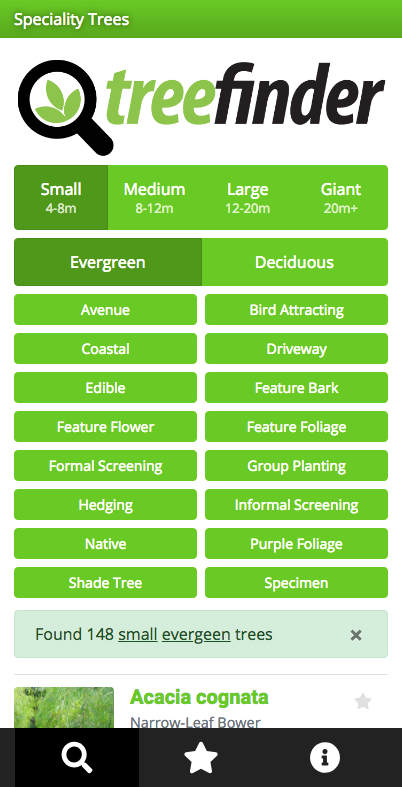
Treefinder can help you identify the perfect tree for your next project!
With over 400 tree varieties for review, the Treefinder app enables you to conveniently browse and compile a list of trees suitable for a number of common landscaping uses - from attracting birds to creating a formal screen or hedge. By selecting desired size, foliage, and a few categories, Treefinder opens up a world of possibilities.
Once you've found the perfect tree you can click through to our website for more information, availability and a quote.

We are specialists in the environmentally sustainable production of premium quality advanced landscaping trees and screens.
For more than 49 years Speciality Trees has been a leader in the production and supply of advanced environmentally sustainable, containerised landscape trees for local government, the landscaping industry and retailers.
Learn more




Trees
© 2026 Speciality Trees Pty Ltd. All Rights Reserved.
Speciality Trees acknowledges the traditional custodians of the lands where we live, learn and work, and acknowledge and respect all who have contributed to it, past, present and future.